

During your personalized individual meetings, EOI benefit counselors will:
Review your benefits package available
Answer questions and provide additional information
Enroll you in your selected benefits for the 2027 plan year
Follow these steps to complete your enrollment using Paycor:



Administered through Cigna
Medical benefits are provided through Cigna. Consider the physician networks, premiums, and out-of-pocket costs for the plan when making a selection. Keep in mind, your choice is effective for the entire 2027 plan year unless you have a Qualifying Life Event.
For employees enrolling in coverage for the first time or changing coverage, ID cards will be mailed directly to your home in a plain white envelope. Please watch your mail carefully, as these envelopes are often mistaken for junk mail.
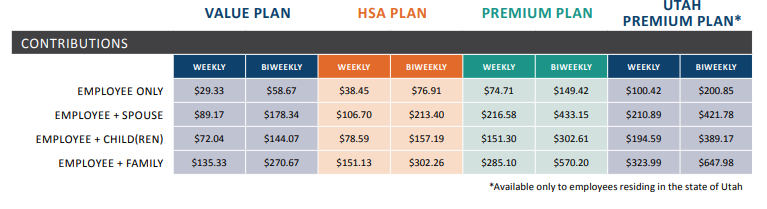
Premium contributions for medical are deducted from your paycheck on a pre-tax basis. Your level of coverage determines your contributions.
Visit cigna.com and click Find a Doctor at the top of the page or call 800-244-6224 for a list of Cigna network providers.
This chart summarizes the 2027 medical coverage provided by Cigna. All covered services are subject to medical necessity as determined by the plan. Please note that all out-of-network services are subject to Reasonable and Customary (R&C) limitations.
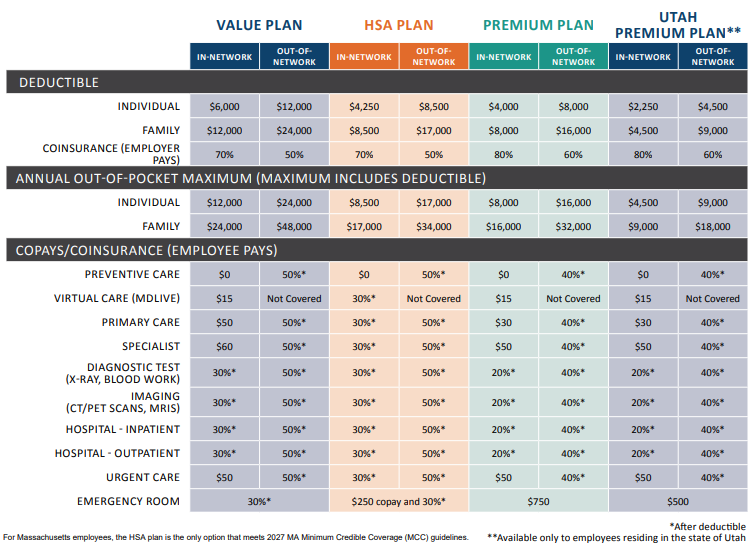
The individual deductible amount must be met by each member enrolled under your medical coverage. If you have several covered dependents, all charges used to apply toward a “per individual” deductible amount will also be applied toward the “per family” deductible amount. When the family deductible amount is reached, no further individual deductibles will have to be met for the remainder of that plan year. No member may contribute more than the individual deductible amount to the “per family” deductible amount. The same applies for the out-of-pocket maximum.


Take control of your spending! A Flexible Spending Account (FSA) is a special tax-free account you put money into to pay for certain out-of-pocket expenses. Visit benefitslogin.wexhealth.com or call 866-451-3399 for more information.
With a WEX Healthcare FSA, you can contribute up to $3,400* annually for qualified medical expenses (deductibles, copays, coinsurance, menstrual products, PPE, over-the-counter medications, etc.) with pre-tax dollars, which reduces your taxable income and increases your take-home pay. You can even pay for eligible expenses with an FSA debit card at the same time you receive them — no waiting for reimbursement.
In addition to the Healthcare FSA, you may opt to participate in the Dependent Care FSA — even if you don’t elect any other benefits. Set aside pre-tax funds into a Dependent Care FSA for expenses associated with caring for elderly or child dependents. Unlike the Healthcare FSA, reimbursement from your Dependent Care FSA is limited to the total amount that is currently deposited in your account.
With the Dependent Care FSA, you can set aside up to $7,500 to pay for child or elder care expenses on a pre-tax basis.
Eligible dependents include children under 13 and a spouse or other individual who is physically or mentally incapable of self-care and has the same principal place of residence as the employee for more than half the year.
You must provide the tax identification number or Social Security number of the party providing care to be reimbursed.
This account covers dependent daycare expenses that are necessary for you and your spouse to work or attend school full time. Eligible expenses include:
In-home babysitting services (not provided by a dependent)
Care of a preschool child by a licensed nursery or daycare provider
Before- and after-school care
Day camp
In-house dependent daycare
Due to federal regulations, expenses for your domestic partner and your domestic partner’s children may not be reimbursed under the FSA programs. Check with your tax advisor to determine if any exceptions apply.



Want funds handy to help cover out-of-pocket healthcare expenses? A Health Savings Account (HSA) with HSA Bank is a personal healthcare bank account used to pay for qualified medical expenses. HSA contributions and withdrawals for qualified healthcare expenses are tax-free. You must be enrolled in an HDHP to participate. Visit hsabank.com or call 800-357-6246 for more information.
Your HSA can be used for qualified expenses for you, your spouse, and/or tax dependent(s), even if they’re not covered by your plan. If you are not currently enrolled in an HDHP but you have unused HSA funds from a previous account, those funds can still be used for qualified expenses.
HSA Bank will issue you a debit card with direct access to your account balance. Use your debit card to pay for qualified medical expenses — no need to submit receipts for reimbursement. Like a regular debit card, you must have a balance in your HSA account to use the card.
Eligible expenses include doctors’ visits, eye exams, prescription lenses, laser eye surgery, menstrual products, PPE, over-the-counter medications, and more. Visit IRS Publication 502 on www.irs.gov for a complete list.


Like brushing and flossing, visiting your dentist is an essential part of your oral health. RoadSafe offers affordable plan options from MetLife for routine care and beyond. Visit www.metlife.com or call 800-275-4638 for more information. Group Number: 255734.
If your dentist doesn’t participate in your plan’s network, your out-of-pocket costs will be higher, and you are subject to any charges beyond the Reasonable and Customary (R&C). To find a network dentist, visit MetLife at metlife.com/mybenefits.
Dental premium contributions are deducted from your paycheck on a pre-tax basis. Your tier of coverage determines your premium.
This chart summarizes the dental coverage provided by MetLife for 2027. MetLife Dental does not issue dental ID cards. Simply let your provider know that you have coverage through MetLife, and they will be able to verify your benefits using your name and date of birth.


Getting your eyes checked regularly is important even if you don’t wear glasses or contacts. We provide quality vision care for you and your family through Eyemed.
Please note: New EyeMed ID cards will not be issued for the 2027 plan year. Continue using your current ID card.
For employees enrolling in coverage for the first time, ID cards will be mailed directly to your home in a plain white envelope. Please watch your mail carefully, as these envelopes are often mistaken for junk mail.
Website: eyemed.com
Phone: 866-723-0513
Group Number: 1052278
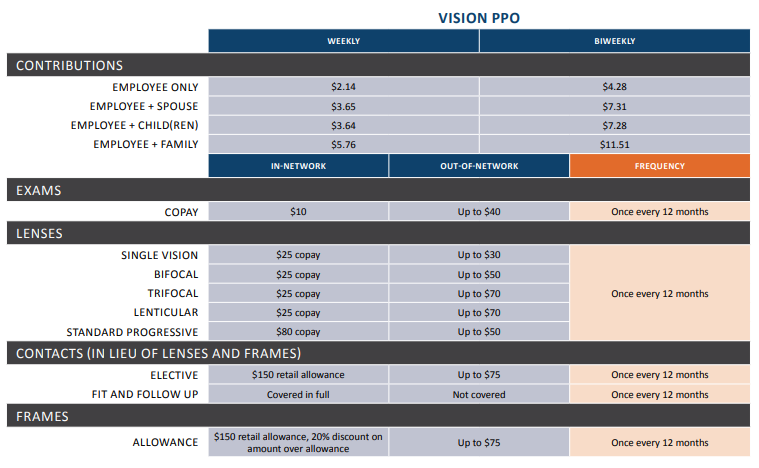
Vision premium contributions are deducted from your paycheck on a pre-tax basis. Your tier of coverage determines your premium.
This chart summarizes the vision coverage provided by Eyemed for 2027.
Industrial Eyes offers a full line of ANSI Z87.1-2010 safety frames and lenses made to order with your prescription. Lenscrafters, Target Optical, Fore Eyes, and participating Pearle Vision Stores will process the glasses in 5–10 days (special orders are excluded from this time frame). RoadSafe covers up to $100 of the cost of your complete pair of safety glasses annually. Additional add-on features will be at the employee’s expense.
You must obtain an authorization form from HR and take this with you to your appointment. The form is located in Benefits Advisor in PayCor.


It’s hard to think about, but it’s important to have a plan in place to provide for your family if something were to happen to you. Survivor benefits provide financial protection for your loved ones in the event of an unexpected event.
RoadSafe provides employees with Basic Life and Accidental Death and Dismemberment (AD&D) insurance as part of your basic coverage through MetLife, which guarantees that your spouse or other designated survivor(s) continue to receive benefits after death.
Your beneficiary is the person you designate to receive your Life insurance benefits in the event of your death. This includes any benefits payable under Basic Life. You receive the benefit payment for a dependent’s death under the MetLife insurance.
Name a primary and contingent beneficiary to make your intentions clear. Indicate their full name, address, Social Security number, relationship, date of birth, and distribution percentage. Please note that in most states, benefit payments cannot be made to a minor. If you elect to designate a minor as beneficiary, all proceeds may be held under the beneficiary’s name and will earn interest until the minor reaches age 18. Contact Human Resources or your own legal counsel with any questions.
Your designated beneficiary will receive a benefit of 1x your salary, up to a maximum of $100,000. In addition, Accidental Death and Dismemberment (AD&D) provides a benefit of 1x your salary, up to a maximum of $100,000 if you die or become dismembered due to a specifically covered accident. Basic life and AD&D insurance is 100% paid for by RoadSafe.
Beneficiary information for life policies must be added and maintained through Paycor.
Website: metlife.com/mybenefits
Phone: 800-438-6388


Accident insurance through MetLife provides you with a cushion to help cover expenses and living costs when you get hurt unexpectedly. This plan complements your health insurance by providing benefits to help cover direct or indirect costs that can arise with a serious or minor injury that occurs off the job. You may end up paying out of your own pocket for things like deductibles, copays, transportation, over-the-counter medicine, daycare or sitters, and extra help around the house. With accident insurance, the benefits you receive can help take care of these extra expenses and anything else that comes up.
You will receive a cash benefit for covered injuries and related services for accidents that occur outside of work.
Benefits are paid on a schedule of benefits regardless of any other coverage you have, and you may spend it any way you choose.
Accident coverage is especially helpful for families with young children and those who are active.
Accident coverage provides benefit payments for off-the-job injuries, including but not limited to:
Broken Bones / Dislocations
Lacerations
Burns
Concussions
More
See your plan document for a full schedule of covered injuries and corresponding benefit payments.
MetLife will reward each covered individual with $50 per calendar year for completing one of 52 eligible healthcare screenings. This benefit is payable for wellness tests performed as a result of preventive care.
If you’re enrolled in the HSA plan, RoadSafe pays for the Accident coverage on your behalf. You are automatically enrolled in this benefit.


No one knows what lies ahead on the road through life. Will you be diagnosed with cancer? Will you suffer a stroke or the complete loss of hearing? The signs pointing to a critical illness are not always clear and may not be preventable, but critical illness coverage helps offer financial protection in the event you are diagnosed. Critical illness insurance through MetLife pays you cash to use in any way you need if you are diagnosed with a covered condition. Visit www.metlife.com or call 800-438-6388 for more information.
Alzheimer’s disease
Cancer
Heart attack
Kidney failure
Stroke
Major organ transplant
Coronary artery bypass graft
Critical illness provides you a lump-sum benefit upon diagnosis of a covered illness.
You have the choice of $15,000 or $30,000 in guaranteed issue coverage. Spouses can be covered at 100% and children at 50% of your elected amount.
Rates are age-banded. Please refer to the benefit summary for a full rate table.
Pre-existing conditions are waived.
A $50 wellness benefit is payable each year for enrollees and their covered dependents for receiving a qualifying preventive screening.


You already know the importance of living well and staying well. But life is unpredictable — expenses associated with a hospital stay can be financially difficult if you are not prepared. Hospital indemnity insurance through MetLife pays cash benefits directly to you if you have a covered stay in a hospital or critical care unit (ICU). Visit www.metlife.com or call 800-438-6388 for more information.
Hospital indemnity pays a cash benefit for hospital admissions due to a covered accident, illness, or pregnancy.
Popular with those planning to have children, who are older or have conditions that subject them to a higher risk of hospitalization, and/or are covered by an HDHP.
Pre-existing conditions are waived.
Benefits are payable for both admissions and additional days spent in the hospital.
This policy does not coordinate with any other coverage, so you can still receive benefits on top of what your medical plan provides.
MetLife will reward each covered individual with $50 per calendar year for completing one of 52 eligible healthcare screenings. This benefit is payable for wellness tests performed as a result of preventive care.


You visit your doctor when you’re feeling sick, and you exercise and eat healthy to keep your body strong. But your mental health is just as important. What do you do to stay healthy mentally? Do you know where you can go when you need help? Whether you need assistance with work-life balance or anxiety, there are resources available to help you out.
An important aspect of your overall wellbeing is emotional wellness — the ability to successfully adapt to changes and challenges as they arise and handle life’s stresses. These five actions have been shown to improve emotional wellness.
Practice mindfulness.
Practice deep breathing, take a walk, enjoy nature, and stay present in each moment.
Strengthen social connections.
Reach out to a friend or family member daily — even if it’s just a call or text.
Get quality sleep.
Keep a consistent sleep schedule and limit electronic use before bed.
Improve your outlook.
Treat people with kindness, including yourself.
Deal with your stress in healthy ways.
Think positively, exercise regularly, and set priorities.


No matter what point of your career you’re in, it’s never a bad time to think about your future and save for retirement.
Contributing to a 401(k) account now can help keep you financially secure later in life. The RoadSafe 401(k) plan provides you with the tools you need to prepare. Reach out to Principal at 800-547-7754 for more information.
This employer-sponsored retirement account can help your future self by saving money — tax-free — from your paycheck. The sooner you participate in a 401(k), the more time your assets have to grow.
Eligible employees can invest for retirement while receiving tax advantages. The company will match 50% of the employee’s deferral, up to 5% of your pay that you contribute to the plan. If you choose to elect more than 5% deferral, the max company match is 2.5%. Administrative services are provided by Principal. You may start making pre-tax or Roth contributions (or both) into the plan on the first of the month following 60 days of employment. You must be at least 18 years of age to be eligible.
To make changes to your deferral rate, opt out, or request a loan (not to exceed one loan at a time), you must call Principal directly or go to their website.
Pre-tax vs. Roth 401(k): What’s the difference?
If you contribute to your 401(k) pre-tax, your contributions are taken out before taxes each pay period, which will lower your annual taxable income. Pre-tax contributions grow on a tax-deferred basis and you won’t pay taxes on these dollars until a distribution is taken at retirement. If you choose the available Roth 401(k), contributions are deducted from your paycheck after taxes — so although you are paying taxes on those dollars now, you won’t pay taxes when you withdraw during retirement.


RoadSafe wants you to succeed in all aspects of life, so we offer a variety of additional benefits to make your day-to-day easier.
Pet Insurance
Prepaid Legal Coverage
Tuition Assistance
PerkSpot Discount Program
General Motors Supplier Discount
Rental Car Discounts
RoadSafe Safety Boot Program
Dell Member Purchase Program
GEDWorks Program
Kashable Short Term Loans