





logo-stlukes

Learn More about Medicare

If you or your spouse are 65 years or over or will turn 65 in the next 12 months, you and your Medicare-eligible family members have the opportunity to get a free personalized Medicare Consultation that will compare Medicare to your St. Luke's Hospital benefit options.

Licensed representatives are available to speak with you!
▼

With a Senior Benefits Advisor, you will receive the support
you need in order to understand your options including:
 

MedicareEligibility

Eligibility 

MedicareCost

Costs & Potential Penalties

MedicareBenefits

Benefits & Coverage

MedicareHowtoEnroll

When & How to Enroll

shutterstock_352315112_square_Web

Speak with a Senior Benefits Advisor

Our licensed Senior Benefits Advisors will be available to speak with you from August 5 - 16, 2024 to discuss your questions. During your individual appointment, you will receive the support you need in order to understand your options including: 

  • Eligibility
  • Costs and potential penalties
  • Review plan options, changes and selections
  • When and how to enroll
Schedule Your Telephonic Appointment

Helpful Information

What is Medicare? ▼

Medicare is federal health insurance for people 65 or older, some younger people with disabilities, people with End-Stage Renal Disease.

  • Part A (Hospital Insurance): Helps cover inpatient care in hospitals, skilled nursing facility care, hospice care, and home health care
  • Part B (Medical Insurance): Helps cover services from doctors and other health care providers, outpatient care, home health care, durable medical equipment (like wheelchairs, walkers, hospital beds, and other equipment), and many preventive services (like screenings, shots or vaccines, and yearly “Wellness” visits)
  • Part D (Drug Coverage): Helps cover the cost of prescription drugs (including many recommended shots or vaccines). Plans that offer Medicare drug coverage (Part D) are run by private insurance companies that follow rules set by Medicare.


Learn more about Part A, B, and D below

Medicare Part A ▼

Part A (Hospital Insurance): Helps cover inpatient care in hospitals, skilled nursing facility care, hospice care, and home health care.

What do I pay for Part A-covered services?

Copayments, coinsurance, or deductibles may apply for each service listed on the following pages. If you’re in a Medicare Advantage Plan or have other insurance (like Medigap, Medicaid, employer, retiree, or union coverage), your copayments, coinsurance, or deductibles may be different. 

Part A-covered services

  • Blood: If the hospital gets blood from a blood bank at no charge, you won’t have to pay for it or replace it. If the hospital has to buy blood for you, you must either pay the hospital costs for the first 3 units of blood you get in a calendar year, or you or someone else can donate the blood.
  • Home health services: Part A and/or Part B covers home health benefits. 
  • Hospice care: To qualify for hospice care, a hospice doctor and your doctor (if you have one) must certify that you’re terminally ill, meaning you have a life expectancy of 6 months or less. When you agree to hospice care, you’re agreeing to comfort care (palliative care) instead of care to cure your terminal illness. You also must sign a statement choosing hospice care instead of other Medicare-covered treatments for your terminal illness and related conditions.
  • Inpatient hospital care: Medicare covers semi-private rooms, meals, general nursing, drugs (including methadone to treat an opioid use disorder), and other hospital services and supplies as part of your inpatient treatment. This includes care you get in acute care hospitals, critical access hospitals, inpatient rehabilitation facilities, long-term care hospitals, psychiatric care in inpatient psychiatric facilities, and inpatient care for a qualifying clinical research study. This doesn’t include private-duty nursing, a television or phone in your room (if there’s a separate charge for these items), personal care items (razors or slipper socks), or a private room, unless medically necessary. If you also have Part B, it generally covers 80% of the Medicare-approved amount for doctors’ services you get while you’re in a hospital.
  • Religious non-medical health care institution (inpatient care): If you qualify for inpatient hospital or skilled nursing facility care in these facilities, Medicare will only cover inpatient, non‑religious, non-medical items and services, like room and board, and items or services that don’t need a doctor’s order or prescription (like unmedicated wound dressings or use of a simple walker). Medicare doesn’t cover the religious portion of this type of care.
  • Skilled nursing facility care: Medicare only covers skilled nursing facility care after a 3-day minimum medically necessary inpatient hospital stay* (not including the day you leave the hospital) for an illness or injury related to the hospital stay. Medicare covers semi-private rooms, meals, skilled nursing and therapy services, and other
    medically necessary services and supplies in a skilled nursing facility. To qualify for skilled nursing facility care, your doctor must certify that you need daily skilled care (like intravenous fluids/medications or physical therapy) which, as a practical matter, you can only get as a skilled nursing facility inpatient. Medicare doesn’t cover non-medical long-term care. You may get skilled nursing care or therapy if it’s necessary to improve or maintain your current condition. If you disagree with your discharge, you can appeal. For example, if you’re discharged only because you aren’t improving, but you still require skilled nursing or therapy care to keep your condition from getting worse, you can appeal.

Speak with a Senior Benefits Advisor to learn more about Medicare Part A.

Most Common National Enrollment Period ▼

Initial Enrollment Period

  • Dates: When you first become eligible for Medicare
  • When you first become eligible for Medicare, you can join a Medicare Advantage Plan. If you joined a Medicare Advantage Plan during your Initial Enrollment Period, you can switch to another Medicare Advantage Plan (with or without drug coverage) or go back to Original Medicare (with or without a separate Medicare drug plan) within the first 3 months you have Medicare.

General Enrollment Period:

  • Dates: January 1 to March 31
  • If you have Part A coverage and you get Part B for the first time during this period, you can also join a Medicare Advantage Plan. Your coverage starts the first day of the month after you sign up. Remember, you must have both Part A and Part B to join a Medicare Advantage Plan.

Open Enrollment Period

  • Dates: August 15 - December 7
  • You can join, switch, or drop a Medicare Advantage Plan during the Open Enrollment Period each year. Your coverage starts on January 1 (as long as the plan gets your enrollment request by December 7). If you join a Medicare Advantage Plan during this period but change your mind, you can switch back to Original Medicare or change to a different Medicare Advantage Plan (depending on which coverage works better for you) during the Medicare Advantage Open Enrollment Period (January 1 – March 31) described on the next page.

Medicare Part B ▼

Medicare Part B (Medical Insurance) helps cover medically necessary doctor’s services, outpatient care, home health services, durable medical equipment, mental health services, and other medical services. Part B also covers many preventive services.

Medicare may cover some services and tests more often than the timeframes listed if needed to diagnose or treat a condition.

 To find out if Medicare covers a service that isn’t on this list or for more on Part-B covered services, speak with a Senior Benefits Advisor.

Medigap Plan Options ▼

The chart below shows basic information about the different benefits that Medicare Supplement Insurance (Medigap) plans cover for 2024. If a percentage appears, the Medigap plan covers that percentage of the benefit, and you’re responsible for the rest.
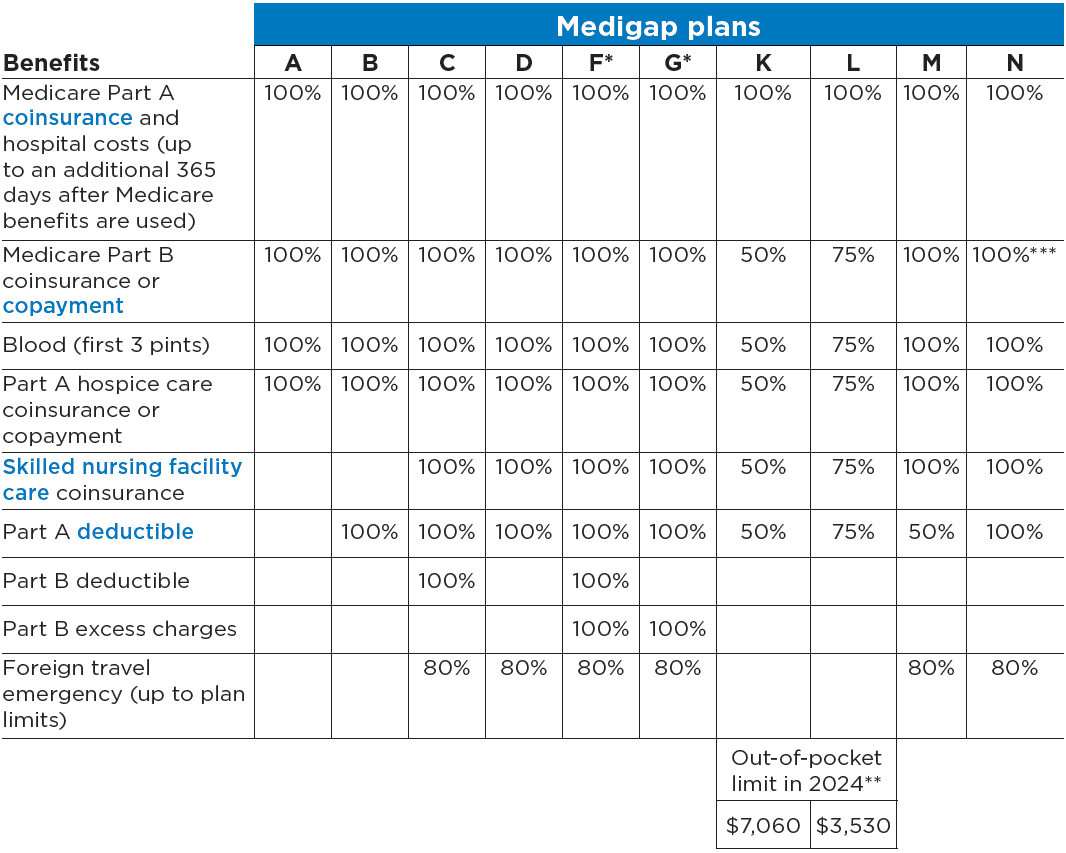
Medigap Plan Options

Click image to enlarge

* Plans F and G also offer a high-deductible plan in some states. With this option, you must pay for Medicare-covered costs (coinsurance, copayments, and deductibles) up to the deductible amount of $2,800 in 2024 before your policy pays anything. (You can’t buy Plans C and F if you were new to Medicare on or after January 1, 2020.

** For Plans K and L, after you meet your out-of-pocket yearly limit and your yearly Part B deductible ($240 in 2024), the Medigap plan pays 100% of covered services for the rest of the calendar year.

***Plan N pays 100% of the Part B coinsurance. You must pay a copayment of up to $20 for some office visits and up to a $50 copayment for emergency room visits that don’t result in an inpatient admission.

Before you can buy Medicare Supplement Insurance (Medigap), you must generally have Part A and Part B. With Medigap, you pay a monthly premium to a private insurance company in addition to the monthly Part B premium you pay to Medicare. If you're thinking about buying Medigap, be sure to compare plans. The costs can vary between plans offered by different companies for exactly the same coverage, and may go up as you get older. Some states limit Medigap premium costs. A Medigap policy only covers one person. Spouses must buy separate coverage.

Frequently Asked Questions

  • Can I buy Medigap and a separate Medicare drug plan from the same company?
    Yes. But you may need to make 2 separate premium payments. Contact the company to find out how to pay your premiums.
  • Can I have drug coverage in both Medigap and my Medicare drug plan?
    No. 
    Note: In some states, you may be able to buy another type of Medigap policy called Medicare SELECT. Medicare SELECT is a type of Medigap policy sold in some states that requires you to use hospitals and, in some cases, doctors within its network to be eligible for full insurance benefits (except in an emergency). If you buy Medicare SELECT, you have rights to change your mind within 12 months and switch to standard Medigap.
  • When's the best time to buy a Medigap policy?
    The best time to buy a Medigap policy is during your Medigap Open Enrollment Period. This 6-month period begins the first month you have Medicare Part B (Medical Insurance), and you’re 65 or older. (Some states have additional Open Enrollment Periods.) After this enrollment period, you may not be able to buy a Medigap policy or it may cost
    more. In certain situations, you may have rights to buy a Medigap policy (guaranteed issue rights) outside of your Medigap Open Enrollment Period.
    If you delay signing up for Part B because you have group health coverage based on your (or your spouse’s) current employment, your Medigap Open Enrollment Period won’t start until you sign up for Part B.
    Federal law generally doesn’t require insurance companies to sell Medigap to people under 65. If you’re under 65, you might not be able to buy the policy you want, or any policy, until you turn 65. However, some states require Medigap insurance companies to sell Medigap policies to people under 65. If you’re able to buy one, it may cost more.

Speak with a Senior Benefits Advisor to learn more about Medigap.

Medicare Part D ▼

Medicare drug coverage (Part D) helps pay for prescription drugs you need. It’s optional and offered to everyone with Medicare. Even if you don’t take prescription drugs now, consider getting Medicare drug coverage. If you decide not to get it when you’re first eligible, and you don’t have other creditable prescription drug coverage (like drug coverage from an employer or union) or get Extra Help, you’ll likely pay a late enrollment penalty if you join a plan later. Generally, you’ll pay this penalty for as long as you have Medicare drug coverage. To get Medicare drug coverage, you must join a Medicare-approved plan that offers drug coverage. Each plan can vary in cost and specific drugs covered. 

There are 2 ways to get Medicare drug coverage (Part D):

  1. Medicare drug plans. These plans add Medicare drug coverage (Part D) to Original Medicare, some Medicare Cost Plans, some Medicare Advantage Private Fee-for-Service Plans, and Medicare Advantage Medical Savings Account (MSA) Plans. You must have Part A and/or Part B to join a separate Medicare drug plan.
  2. Medicare Advantage Plans or other Medicare health plans with drug coverage. You get your Part A, Part B, and Medicare drug coverage (Part D) through these plans. Remember, you must have Part A and Part B to join a Medicare Advantage Plan, and not all Medicare Advantage Plans offer drug coverage.

In either case, you must live in the service area of the plan you want to join and be lawfully present in the U.S. 

Speak with a Senior Benefits Advisor to learn more about Medicare Part D.

Schedule Your Appointment

Senior Benefits Advisors are available to help you with your free personalized Medicare Consultation that will compare Medicare to your St. Luke's Hospital benefit options.

Schedule Your Telephonic Appointment


EOI Service Company is an insurance agency not affiliated with the government. We do not offer every plan available in your area. We currently represent six organizations which offer over 100 products in your area. Please contact Medicare.gov, 1-800-MEDICARE, or your local State Health Insurance Program (SHIP) to get information on all of your options.

Shutterstock_square5